
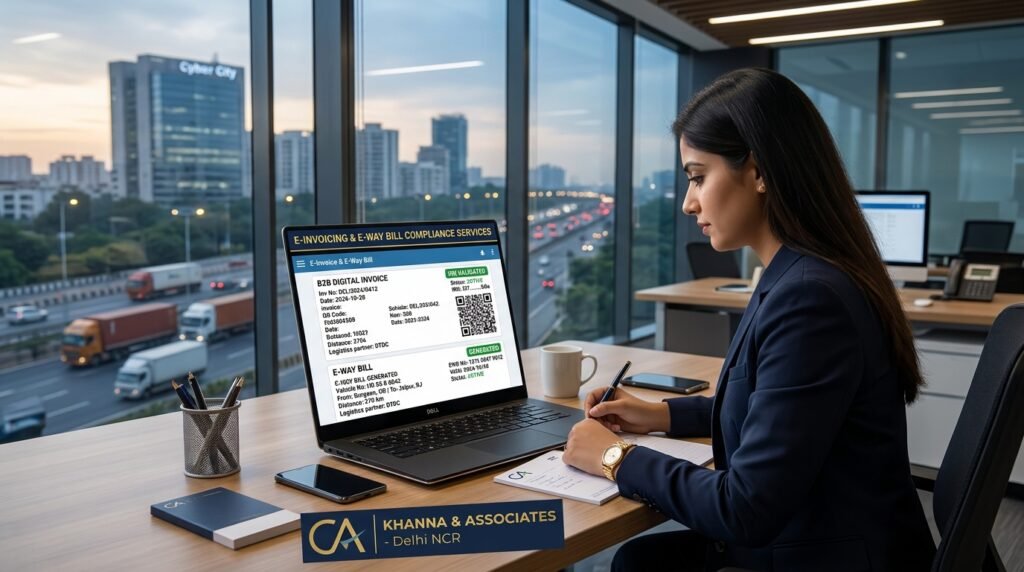
E-Invoicing & E-Way Bill Compliance Services in Delhi NCR
Seamless IRN Generation, ERP/Accounting Software Integration, E-Way Bill Management & Penalty Prevention by Chartered Accountants
In modern indirect taxation in India, physical paper invoices and non-integrated billing systems are no longer compliant for growing businesses. With the mandatory phased implementation of electronic invoicing (E-Invoicing) under Rule 48(4) of the CGST Rules and real-time electronic tracking under Rule 138 (E-Way Bills), any commercial transaction without an authenticated Invoice Reference Number (IRN) and signed QR code is legally deemed invalid. This directly jeopardizes your buyers’ ability to avail Input Tax Credit (ITC) and exposes your business to severe detention and compounding penalties.
Ankush Aggarwal & Associates is a premier Chartered Accountant (CA) firm in Delhi NCR offering end-to-end E-invoicing and E-way bill services. Our specialized team helps manufacturers, distributors, exporters, B2B wholesalers, and corporate enterprises across Delhi, Noida, Gurgaon, and Faridabad configure automated IRN generation, integrate ERP and accounting software (Tally, Busy, SAP, Zoho, Oracle), reconcile portal logs, and maintain flawless logistical compliance.
E-Invoicing Applicability: Current Turnover Limits & Phase Roadmap
The Central Board of Indirect Taxes and Customs (CBIC) has progressively lowered the aggregate annual turnover threshold for mandatory e-invoicing. If your aggregate turnover in any preceding financial year from 2017-18 onwards crossed the threshold, e-invoicing applies permanently:
| Implementation Phase | Turnover Threshold | Effective Date | Status |
|---|---|---|---|
| Phase I | Turnover exceeding ₹500 Crores | 1st October 2020 | Mandatory Active |
| Phase II | Turnover exceeding ₹100 Crores | 1st January 2021 | Mandatory Active |
| Phase III | Turnover exceeding ₹50 Crores | 1st April 2021 | Mandatory Active |
| Phase IV | Turnover exceeding ₹20 Crores | 1st April 2022 | Mandatory Active |
| Phase V | Turnover exceeding ₹10 Crores | 1st October 2022 | Mandatory Active |
| Phase VI (Current) | Turnover exceeding ₹5 Crores | 1st August 2023 onwards | Mandatory Active |
Note: E-invoicing applies to B2B supplies, export invoices, SEZ supplies, and credit/debit notes. It is not currently mandatory for B2C supplies, banks/NBFCs, GTA (goods transport agencies), passenger transport, and multiplexes.
How E-Invoicing Works: From ERP to IRN Generation
E-invoicing does not mean generating invoices directly on the government portal. Instead, invoices are created in your accounting system and reported to the Invoice Registration Portal (IRP) for validation:
- Invoice Creation: Taxpayer creates invoice in ERP or accounting software adhering to the standardized schema (INV-01) with mandatory fields (HSN code, tax rates, buyer GSTIN, dispatch address).
- JSON File Payload Generation: The software prepares a JSON string containing invoice data and transmits it to an approved IRP (e.g., NIC, Clear, Cygnet, Adaequare).
- Validation & Hash Generation: The IRP validates data integrity, checks for duplication, and computes a unique 64-character hash known as the Invoice Reference Number (IRN).
- Digital Signature & QR Code: The IRP digitally signs the JSON payload, generates an encrypted QR code containing vital parameters, and returns it to the seller’s software.
- Auto-Population to GSTR-1 & E-Way Bill: The IRP automatically transmits verified invoice data to the GST common portal (populating GSTR-1) and the E-Way Bill system simultaneously.
E-Way Bill Compliance (Rule 138): Key Provisions & Validity
An E-Way Bill (Electronic Way Bill) is mandatory for the movement of goods whose consignment value exceeds ₹50,000 (for interstate movement and intrastate movement in Delhi NCR):
Parts of an E-Way Bill (EWB-01)
- Part A: Invoice number, date, value, HSN code, recipient GSTIN, dispatch location, and pin code. Auto-generated instantly when e-invoice is created.
- Part B (Transport Details): Vehicle number, transporter ID (TRANSIN), or railway/air/ship receipt number. Can be updated dynamically during transit.
Statutory Validity Limits
- Normal Cargo: 1 day for distance up to 200 km; +1 additional day for every additional 200 km or part thereof.
- Over Dimensional Cargo (ODC) / Multimodal: 1 day for distance up to 20 km; +1 day for every additional 20 km.
- Extension Window: E-Way Bill can be extended within 8 hours before or 8 hours after the expiry time.
Penalties for E-Invoice and E-Way Bill Violations
The consequences of non-compliance with e-invoicing and e-way bill mandates are immediate and financially crippling:
- Non-Issuance of E-Invoice (Section 122(1)): 100% of the tax due or ₹10,000, whichever is higher, per invoice. Under Rule 48(5), any invoice issued without an IRN is legally treated as if no invoice was issued.
- Denial of Buyer’s Input Tax Credit (ITC): Buyers cannot claim ITC on an invoice lacking a valid QR code and IRN. This results in commercial backlash, withheld payments, and loss of institutional clients.
- Goods Detention & Vehicle Seizure (Section 129): Transporting goods without a valid E-Way Bill or with expired validity attracts:
- Where owner comes forward: Penalty equal to 200% of tax payable on goods.
- Where owner does not come forward: 50% of the value of goods or 200% of tax, whichever is higher.
- Blocking of E-Way Bill Facility (Rule 138E): Failure to file GSTR-3B or CMP-08 for two consecutive tax periods automatically blocks your GSTIN on the E-Way bill portal, bringing your physical supply chain to an immediate halt.
How Ankush Aggarwal & Associates Supports Your Business
As practicing Chartered Accountants with deep technical and taxation expertise, we deliver robust solutions:
- ERP & Billing Software Integration: We configure API-based and GSP-based seamless connectors for Tally Prime, Busy, SAP, Zoho Books, and custom software for one-click IRN and E-Way Bill generation.
- Turnover Audits & Applicability Verification: Independent verification of multi-year aggregate turnover to determine exact e-invoicing liability dates.
- Real-Time E-Way Bill Management & Extension SOPs: Standard Operating Procedures for logistics teams to handle Part B updates, transshipment records, and timely validity extensions.
- Resolution of Detention Notices (Form MOV-02 / MOV-06 / MOV-07): Immediate departmental legal representation to secure quick vehicle release under Section 129 in Delhi, Haryana, and UP borders.
- GSTR-1 to E-Invoice Reconciliation: Monthly true-ups between ERP sales registers, IRP logs, and GSTR-1 tables to ensure zero reporting mismatches.
Frequently Asked Questions on E-Invoicing & E-Way Bills
1. Is there a time limit to report an invoice on the IRP portal?
For taxpayers with aggregate turnover of ₹100 Crores or more, CBIC enforces a 30-day time limit to report invoices, credit notes, and debit notes on the IRP from the date of the document. For other taxpayers, real-time reporting is recommended as buyers expect immediate reflection in GSTR-2B.
2. Can an E-Invoice (IRN) be modified or edited once generated?
No. An IRN cannot be modified or edited once generated. If there is a mistake in an e-invoice, the only option is to cancel the IRN on the IRP within 24 hours of generation. Once cancelled, a new invoice must be issued with a fresh invoice number; the same invoice number cannot be re-used.
3. Is an E-Way Bill required if goods are transported within the same city in Delhi?
In the National Capital Territory of Delhi, an intrastate E-Way Bill is required if the consignment value exceeds ₹1,00,000 for all goods (except specific exempted goods or intra-city movement within 50 km for weighing purposes). For interstate movement to Noida, Gurgaon, or Ghaziabad, the threshold is strictly ₹50,000.
4. Does e-invoicing eliminate the need to generate an E-Way Bill?
No, but it simplifies it significantly. While generating the e-invoice, if you include Part B transport details (vehicle number or transporter ID) in the payload, the IRP will automatically generate both the IRN and the E-Way Bill simultaneously in a single step.
5. How do I unblock my GSTIN on the E-Way Bill portal if it was suspended?
If your E-Way Bill generation facility is blocked due to non-filing of GSTR-3B for two or more periods (Rule 138E), you must file all pending returns and discharge taxes. The portal usually unblocks automatically within 24 hours. If not unblocked, our CA team files an application in Form GST EWB-05 before the jurisdictional tax commissioner.
Automate Your Invoicing & Protect Your Supply Chain
Consult our Chartered Accountants for seamless E-Invoicing ERP setup, E-Way Bill training, and rapid detention resolution.
Ankush Aggarwal & Associates | Office: A4, Acharya Niketan, Mayur Vihar Phase 1, Delhi – 110091 | Email: info@aaaa.co.in
