
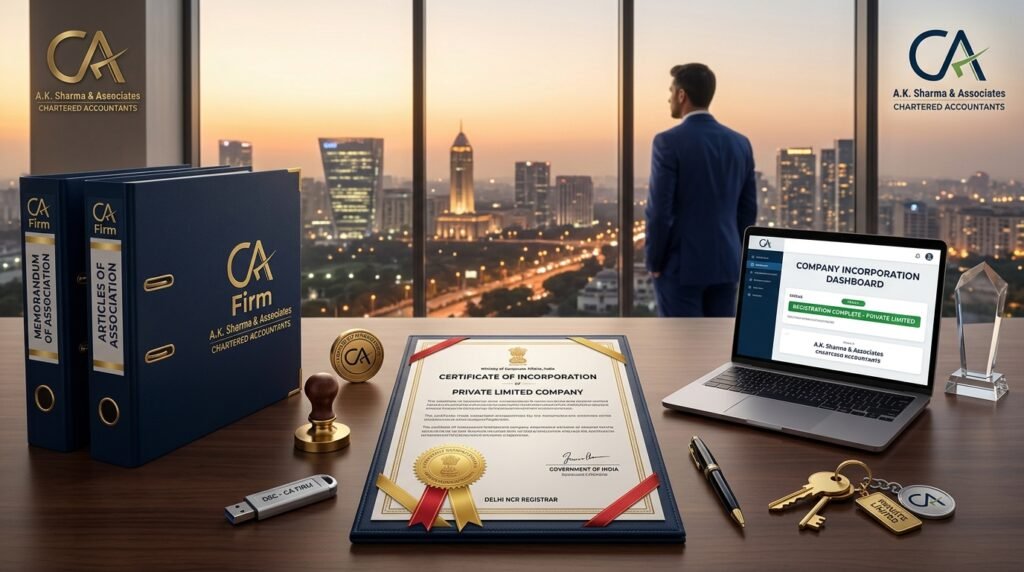
Private Limited Company Registration in Delhi NCR
Fast-Track SPICe+ MCA Incorporation, DIN, DSC, MOA/AOA Drafting & Post-Incorporation Compliance by Chartered Accountants
Are you launching a new startup, expanding a family enterprise, or transforming a proprietorship into an institutional corporate structure in Delhi, Noida, or Gurgaon? A Private Limited Company (Pvt Ltd) is the gold standard corporate entity in India. It offers entrepreneurs a separate legal identity, limited liability protection, 100% corporate ownership separation, and unmatched institutional credibility when raising venture capital, equity financing, or bank credit lines.
Ankush Aggarwal & Associates is a premier Chartered Accountant (CA) firm in Delhi NCR delivering seamless, end-to-end private limited company registration services in Delhi. From our principal office in Mayur Vihar Phase 1, our corporate legal and CA team manages the entire incorporation workflow on the Ministry of Corporate Affairs (MCA) V3 portal — from Name Reservation (RUN/SPICe+ Part A) and Class 3 DSC issuance to drafting tailored e-MOA/e-AOA, securing the Certificate of Incorporation (COI), and executing mandatory Form INC-20A (Commencement of Business) filings.
Why Incorporate a Private Limited Company? Key Advantages
Choosing a Private Limited Company structure over a traditional partnership or proprietorship provides immense commercial, legal, and tax advantages:
Limited Liability Protection
Directors and shareholders have zero personal liability for business debts, bank defaults, or contractual litigation. Personal assets (homes, personal bank savings) remain 100% shielded by the corporate veil.
Venture Capital & Angel Investment
Institutional investors, seed funds, VCs, and angel syndicates strictly require an investee to be a Private Limited Company capable of issuing equity shares, CCPS (compulsorily convertible preference shares), or ESOPs.
Perpetual Succession & Continuity
A company is an independent juristic person created by law. The company continues to exist indefinitely regardless of the death, bankruptcy, resignation, or transfer of shares by any individual director or shareholder.
Concessional Corporate Tax Rates
Domestic companies benefit from attractive concessional tax rates: 22% (+ surcharge and cess) under Section 115BAA (effective ~25.17%), which is significantly lower than individual 30%+ slab rates for high-earning partnerships.
Minimum Statutory Requirements to Incorporate a Company
Under the Companies Act, 2013, incorporating a private limited entity requires meeting these baseline legal criteria:
- Minimum 2 Directors: At least two individuals (maximum 15). At least one director must be a Resident of India (stayed in India for not less than 182 days during the financial year).
- Minimum 2 Shareholders: Can be the same individuals as the directors. Maximum number of shareholders is 200. Shareholders can also be corporate bodies or foreign entities.
- Zero Minimum Paid-Up Capital Requirement: The Companies Act eliminated the minimum paid-up capital requirement of ₹1 Lakh. You can incorporate a company with authorized capital of ₹1,00,000 and paid-up capital as low as ₹2!
- Registered Office Address: A commercial or residential premises in Delhi NCR with valid utility bill (electricity/gas/water < 2 months old) and landlord No Objection Certificate (NOC).
- Unique Company Name: A distinct name adhering to the MCA Name Availability Guidelines (not identical or resembling existing registered companies or registered trademarks under Class 45).
Our 5-Step Company Registration Process (SPICe+ MCA V3)
Our Chartered Accountants manage the entire online incorporation through the MCA integrated SPICe+ ecosystem:
- Class 3 Digital Signature Certificate (DSC) Issuance: We generate encrypted Class 3 DSC tokens for all proposed directors to sign electronic incorporation web-forms.
- Name Reservation (SPICe+ Part A): We conduct comprehensive ROC and Trademark registry searches, drafting two preferred name proposals highlighting your core business activity for swift Central Registration Centre (CRC) approval.
- Drafting Charter Documents (e-MOA & e-AOA): We draft tailored Memorandum of Association (INC-33) defining business objects and Articles of Association (INC-34) governing internal shareholder governance, board voting, and share transfer rules.
- Filing SPICe+ Part B & Integrated Registrations (AGILE-PRO-S): In a single integrated electronic submission, we apply for:
- Company Incorporation (COI with CIN)
- Director Identification Numbers (DIN) for new directors
- Company PAN and TAN
- EPFO (Provident Fund) and ESIC (Employee State Insurance) registrations
- Professional Tax registration (where applicable)
- Corporate Bank Account opening with partner bank
- GST Registration (optional via AGILE-PRO-S)
- Certificate of Incorporation (COI) Issuance: The CRC approves the application, issuing the digitally signed Certificate of Incorporation bearing the unique 21-digit Corporate Identity Number (CIN).
Documents Checklist for Company Registration
| Document Category | Required Documents |
|---|---|
| Identity Proof (Directors & Shareholders) | Self-attested copy of PAN Card (Mandatory for Indian nationals) and Passport / Voter ID / Driving License. (Passport mandatory for foreign nationals, duly apostilled/notarized). |
| Address Proof (Directors & Shareholders) | Self-attested Bank Statement / Electricity Bill / Telephone Bill / Mobile Bill (strictly less than 2 months old with name and address exactly matching PAN). |
| Registered Office Proof | Copy of Electricity Bill / Water Bill / Gas Bill of the premises (< 2 months old), Rent Agreement (if rented), and written No Objection Certificate (NOC) from the property owner. |
| Director Particulars | Passport size photograph, active email address, and mobile number linked with Aadhaar for OTP verification. |
Mandatory Post-Incorporation Compliances (First 180 Days)
Incorporation is merely the starting line. The Companies Act imposes critical statutory compliance steps that must be fulfilled immediately:
1. Form INC-20A (Commencement of Business)
Strict Deadline: Within 180 days of incorporation.
Every subscriber must deposit their subscribed share capital into the company bank account. A Chartered Accountant must verify the bank statement and certify Form INC-20A with geotagged registered office photos. Penalty for default: ₹50,000 for company + ₹1,000/day for directors, and ROC may initiate company strike-off!
2. Form ADT-1 (First Auditor Appointment)
Strict Deadline: Within 30 days of incorporation.
The Board of Directors must formally pass a board resolution appointing the First Statutory Auditor of the company (a practicing Chartered Accountant), obtain written consent and eligibility certificate under Section 141, and file Form ADT-1 with the ROC.
3. Share Certificates & Delhi Stamp Duty
Strict Deadline: Within 60 days of incorporation.
The company must issue formal stamped physical share certificates (Form SH-1) to all founding subscribers and pay applicable Delhi Stamp Duty online through the Revenue Department portal within 30 days of allotment.
4. Annual ROC Compliance Docket
Holding First Board Meeting within 30 days, maintaining statutory registers (Registers of Members, Directors, Loans), holding annual AGM by September 30, and filing annual returns in Form AOC-4 (Financials) and Form MGT-7A (Annual Return).
Frequently Asked Questions on Company Registration
1. How long does it take to register a Private Limited Company in Delhi?
Under the streamlined MCA SPICe+ system, once all identity documents and DSC tokens are verified, name approval takes 1 to 2 working days, and final incorporation approval along with PAN, TAN, and Certificate of Incorporation (COI) typically takes 3 to 5 working days.
2. Can a residential apartment or rented flat be used as the registered office?
Yes. The Ministry of Corporate Affairs permits residential premises, rented flats, or home offices to be registered as the official corporate registered office, provided you hold a recent electricity bill (<2 months old) and a signed No Objection Certificate (NOC) from the property owner.
3. Can a salaried employee become a director in a Private Limited Company?
Under company law, there is no statutory prohibition against a salaried person becoming a director. However, you must carefully review your private employment contract with your current employer, as most corporate employment agreements contain exclusivity clauses prohibiting outside directorships or commercial engagements without prior written consent.
4. What is the difference between Authorized Capital and Paid-Up Capital?
Authorized Share Capital is the maximum capital limit up to which a company is legally authorized to issue shares to shareholders as specified in its MOA (commonly kept at ₹1,00,000 or ₹10,00,000 initially). Paid-Up Capital is the actual amount of money paid by shareholders into the company’s bank account for the shares allotted to them.
5. Is a physical visit to the ROC office required during incorporation?
No. The entire incorporation process under the MCA V3 portal is 100% digital and paperless. All document verification, DSC signing, form uploads, government fee payments, and COI downloads are executed online by our Chartered Accountants.
Incorporate Your Company with Expert Chartered Accountants
Fast-track your Private Limited Company incorporation, secure your corporate name, and establish full compliance from Day 1.
Ankush Aggarwal & Associates | Office: A4, Acharya Niketan, Mayur Vihar Phase 1, Delhi – 110091 | Email: info@aaaa.co.in
